Toyota forklifts are designed for long service life, but regular maintenance is still essential to keep them operating reliably. Filters, lift chains, mast rollers, brakes, tires, hydraulic components, and electrical parts all wear over time.
For fleet managers, maintenance technicians, and forklift parts distributors, identifying wear early helps prevent unexpected breakdowns, reduce repair costs, and keep trucks available for daily operations.
This guide covers the common Toyota forklift wear parts, what to inspect during routine maintenance, the signs that indicate replacement is needed, and how to identify the correct replacement parts by model and serial number.
Toyota forklifts, including the 8FG and 8FD engine-powered series, 8FB electric forklifts, Tonero models, and BT warehouse equipment, operate in different environments and under different workloads.
A forklift used for occasional warehouse handling may experience less wear than one operating multiple shifts, handling heavy loads, or working on rough outdoor surfaces.
Even reliable forklifts develop wear in predictable areas. Filters become restricted, chains elongate, rollers wear unevenly, brake components lose thickness, and electrical contacts deteriorate with repeated switching.
Many fleets use a 250-hour service interval as a maintenance reference. However, actual service schedules depend on the forklift model, operating conditions, and manufacturer's recommendations. Always confirm the maintenance interval in the truck's service manual.
Toyota 8FG, 8FD, and Tonero forklifts with internal combustion engines require regular inspection of filtration, ignition, cooling, and transmission components.
Oil, fuel, and air filters
Replace filters according to the manufacturer's maintenance schedule. Restricted air filters can reduce engine performance, while contaminated oil or fuel can accelerate component wear. Check for unusual fuel consumption, reduced power, or difficulty starting.
Spark plugs and ignition components
On LPG and gasoline forklifts, worn spark plugs or ignition components may cause rough idling, misfires, hard starting, or unstable engine performance under load. Inspect electrode condition and spark plug gap according to the engine specifications.
Drive belts and radiator hoses
Check drive belts for cracks, glazing, looseness, or abnormal noise. Inspect radiator hoses for swelling, hardening, leakage, and signs of abrasion.
Cooling system problems should be addressed before they lead to overheating. Water pump bearing noise, coolant leakage, or abnormal temperature changes may indicate a component needs further inspection or replacement.
Transmission oil and filters
Check transmission oil condition during scheduled maintenance. Discoloration, burnt odor, or metal particles may indicate internal wear and should be investigated before continued operation.
Hydraulic components directly affect lifting performance, mast movement, and load handling. A small leak or restriction can gradually reduce productivity before the forklift stops working.
Hydraulic pump
Listen for abnormal whining or noise during operation. Slow lifting, inconsistent lift speed, or reduced performance under load may indicate pump wear, oil contamination, a restriction, or another hydraulic problem. Confirm the cause before replacing the pump.
Hydraulic suction and return filters
Restricted filters can affect oil flow and create symptoms similar to hydraulic pump failure. Check filter condition and replacement intervals before diagnosing more expensive hydraulic components.
Lift chains
Inspect lift chains for rust, damaged links, uneven wear, and lubrication problems. Measure chain elongation during scheduled inspections.
Some service references use approximately 3% elongation as a replacement threshold, but the actual limit must be confirmed against the specific forklift model and manufacturer's specifications.
Chains with kinked links, cracks, significant corrosion, or uneven elongation should not be overlooked even if the overall measurement appears acceptable.
Mast rollers and mast channels
Inspect mast rollers for flat spots, cracks, uneven wear, and excessive play. Check mast channels for damage or abnormal contact.
Worn rollers can cause vibration, binding, uneven mast movement, and additional stress on lift chains and other mast components.
Hydraulic hoses and seals
Check hose routing, fittings, and seals for oil leakage, abrasion, cracking, or damage caused by contact with moving mast sections.
Replace damaged hoses and seals before leakage becomes a safety or operational problem.
Brake components require particular attention because wear directly affects stopping performance and operator safety.
Brake pads and shoes
Measure friction material thickness during scheduled inspections. Replace components before they reach the manufacturer's minimum allowable thickness.
Uneven wear may indicate problems with brake adjustment or other components that should be checked at the same time.
Master cylinders and wheel cylinders
Inspect for fluid leakage and abnormal pedal travel. A soft or spongy brake pedal, reduced braking response, or visible fluid leakage may indicate worn seals or hydraulic problems.
Brake hoses and lines
Check for corrosion, cracks, abrasion, swelling, and contact with surrounding components. Damaged brake lines or hoses should be repaired or replaced promptly.
Tire and wheel wear varies considerably depending on floor conditions, load weight, turning frequency, operating speed, and whether the forklift works indoors or outdoors.
Drive tires
Solid cushion tires are commonly used on indoor warehouse forklifts, while pneumatic tires are often used on outdoor counterbalance trucks.
Inspect tires for uneven wear, chunking, cracks, flat areas, and damage around the tread or sidewall. Replace them according to the manufacturer's wear limits and operating requirements.
Steer wheels and load rollers
BT pallet trucks, stackers, and other warehouse equipment rely heavily on polyurethane load rollers and drive wheels.
Flat spots, surface cracking, uneven wear, or polyurethane separation from the wheel core can cause vibration, difficult movement, and reduced handling performance.
Wheel bearings
Check for abnormal rumbling, excessive play, or rough rotation during wheel inspections and replacement work. Bearing wear can lead to further damage if left unaddressed.
Electric Toyota forklifts in the 8FB series and BT warehouse equipment rely on electrical components for drive, lifting, steering, monitoring, and safety functions.
Battery and connectors
Inspect battery cables, connectors, and terminal areas for loose connections, corrosion, overheating, or discoloration.
For lead-acid batteries, follow the manufacturer's watering and maintenance requirements. Connector damage or poor contact can cause voltage drop and heat buildup.
Contactors
Contactors switch high-current electrical circuits during forklift operation. Inspect for excessive contact wear, pitting, overheating, and abnormal switching behavior.
Clicking without movement, intermittent operation, or contactor chatter may indicate a contactor issue, but the control circuit and other electrical components should also be checked before replacement.
Carbon brushes
DC drive motors and hydraulic pump motors equipped with carbon brushes require periodic brush inspection.
Measure brush length against the specified wear limit. Check for uneven contact, damaged brush holders, weak springs, or excessive carbon dust.
Brushes worn beyond their limit may affect motor performance and damage the commutator.
Controllers and sensors
Repeated fault codes should be diagnosed rather than cleared without investigation.
Controller replacement requires careful compatibility checking, including voltage, current rating, motor type, configuration, and connector or communication requirements.
Instrument clusters
A faulty instrument panel may affect hour-meter readings, warning indicators, or fault-code visibility. Check display function and connections before replacing the meter.
| Wear part | Inspection frequency | Replacement signs |
|---|---|---|
| Oil, fuel, air and hydraulic filters | Scheduled service | Service interval reached, restriction or contamination |
| Lift chains | Every service | Excessive elongation, damaged links, rust, uneven wear |
| Mast rollers | Every service | Flat spots, cracks, binding, excessive play |
| Brake pads and shoes | Every service | Below specified thickness, uneven wear |
| Drive tires | Regular visual inspection | Wear limit reached, chunking, cracks, damage |
| Load rollers | Every service | Flat spots, cracking, polyurethane separation |
| Carbon brushes | Scheduled inspection | Below wear limit, uneven contact, damaged holders |
| Contactors | Scheduled inspection | Pitted contacts, overheating, abnormal switching |
| Hydraulic pump | Performance-based diagnosis | Abnormal noise, reduced lifting performance |
| Spark plugs | Engine service interval | Fouling, erosion, incorrect gap |
| Water pump | Performance-based diagnosis | Bearing noise, coolant leakage |
Inspection frequency should be adjusted according to the forklift's working environment, hours of operation, load conditions, and service manual.
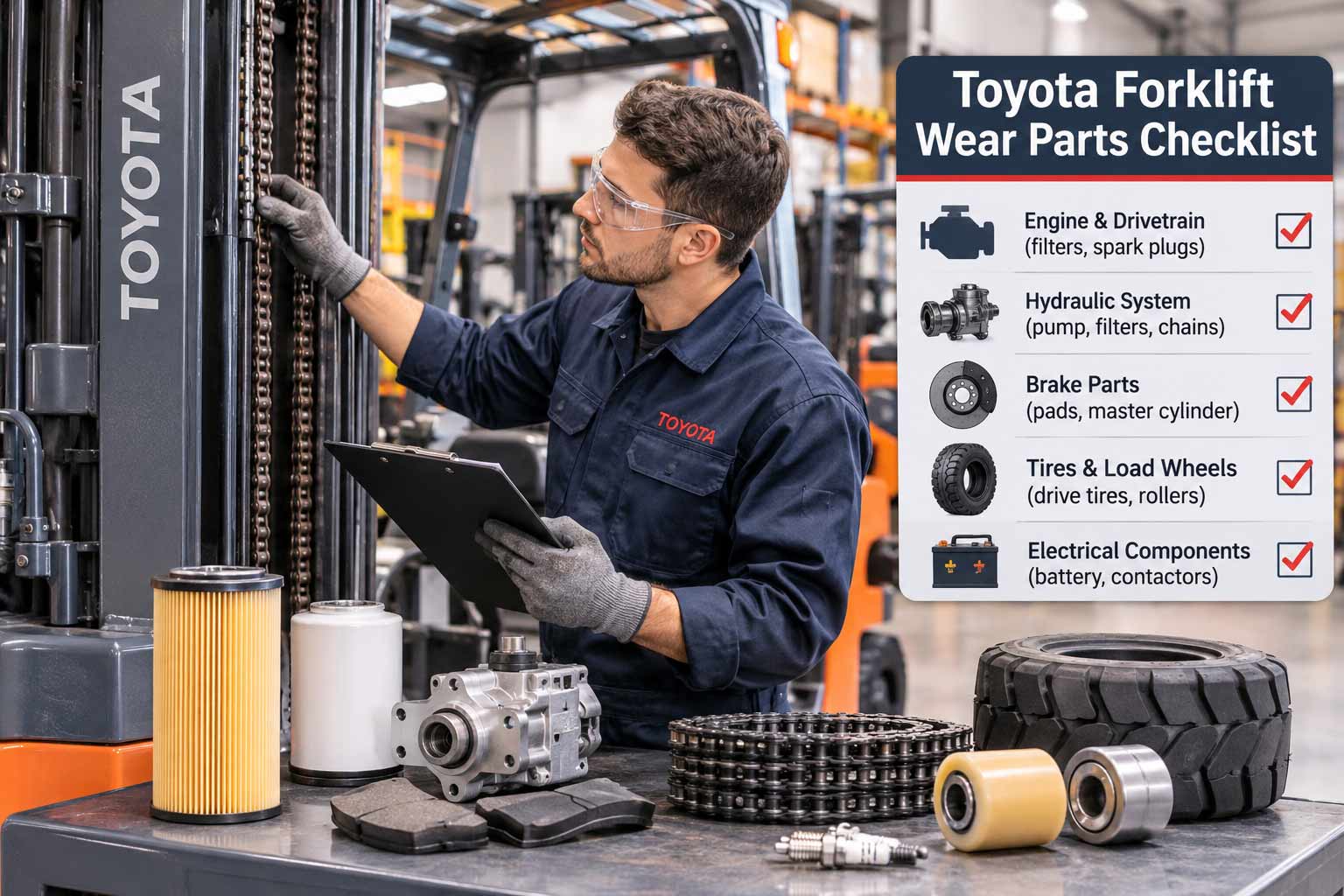
Toyota forklift parts may vary by model, production year, serial range, mast configuration, and installed component. A part that looks similar may not have the same mounting dimensions, electrical specifications, or application.
When sourcing Toyota forklift spare parts, use the following information to verify compatibility.
1. Original part number
The part number on the old component is the most useful starting point. Cross-reference it with the replacement number and verify whether the part number has been superseded.
2. Forklift model and serial number
Provide the complete model and serial number from the forklift data plate. This helps narrow down production specifications and component variations.
3. Photos of the old part
Clear photos of the component, connector, mounting points, labels, and overall dimensions can help identify parts when the original number is missing or unreadable.
4. Technical specifications
For electrical parts, confirm voltage, current rating, connector type, wiring, and application. For mechanical parts, check dimensions, mounting position, and design details.
A combination of part number, model, serial number, and photos is usually more reliable than identification based on model name alone.
Genuine Toyota parts and aftermarket replacement parts can both be used in forklift maintenance, depending on the application, budget, and availability.
Genuine parts offer manufacturer-specific identification and compatibility support. Aftermarket parts can provide additional sourcing options and may be more economical for fleets managing maintenance costs.
However, aftermarket quality and fitment vary between suppliers. Before ordering, confirm:
Compatibility with the forklift model and serial range
Part number or cross-reference information
Electrical and dimensional specifications
Availability and estimated dispatch time
Warranty and after-sales support if the part does not fit
The decision should be based on specification, application, reliability, and supplier support—not price alone.
Finding the right replacement part is often more important than simply finding a part with a similar appearance.
For fleet maintenance teams, repair workshops, and forklift parts distributors, accurate identification helps avoid incorrect orders, unnecessary returns, and additional downtime.
We supply replacement parts for Toyota forklifts and BT warehouse equipment, including engine parts, hydraulic components, mast parts, brake components, wheels, electrical parts, controllers, contactors, carbon brushes, and instrument meters.
When the original part number is available, we can use it for cross-reference checks. If the part number is missing, send the forklift model, serial number, and photos of the old component for identification.
Contact us with your Toyota forklift parts list to check availability, compatibility, and replacement options.
Common wear parts include filters, lift chains, mast rollers, brake pads and shoes, drive tires, load rollers, carbon brushes, contactors, and engine ignition components. Their wear rates depend on truck type and operating conditions.
Some fleets use 250 hours as a routine service reference, but the correct interval depends on the forklift model, workload, environment, and manufacturer's maintenance schedule. Wear parts should be inspected at the appropriate service intervals.
Yes. Aftermarket replacement parts are widely used for maintenance and repair. However, specifications and fitment must be verified against the original part and forklift serial range.
Start with the original part number. If unavailable, provide the forklift model, serial number, photos, and relevant specifications such as voltage, current rating, mounting dimensions, or connector type.
Replace chains when elongation exceeds the manufacturer's limit or when damaged links, corrosion, kinks, cracks, or uneven wear are found. Chain inspection and measurement should follow the applicable service manual.
Polyurethane load rollers and drive wheels often experience significant wear on BT pallet trucks and stackers. Carbon brushes and contactors may also require replacement on certain electric models. Floor condition, load weight, and operating frequency affect service life.
Replacement parts may be available for many older Toyota forklift models. Availability depends on the original part number, truck configuration, and whether the component is still produced or has an aftermarket replacement. Provide the model, serial number, and part details to check the available options.
Get Latest Deals from Anhui LiftTop Mechanical and Electrical

Send Us Email
Email : simon@lifttops.com
Address


 IPv6 network supported


 English
 English
 français
 русский
 español
 português
 العربية