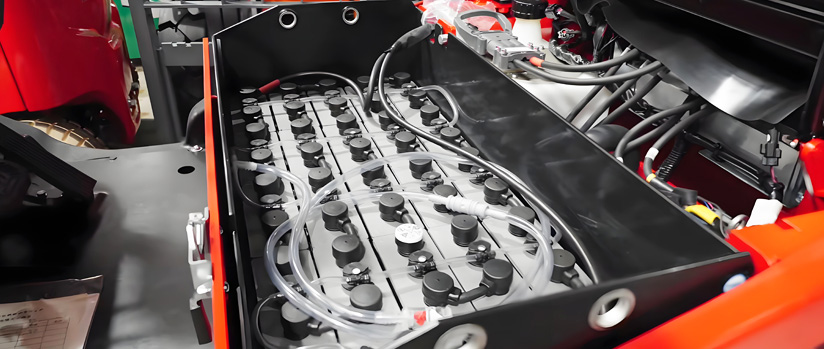
Wondering how to choose heavy-duty forklift batteries for your warehouse? You’ll need to know the key specs, compare lithium-ion versus lead-acid, and get expert advice for multi‑shift, high‑intensity operations.
Modern heavy‑duty warehouses run on non‑stop material movement. Forklifts have to operate for long stretches, handle heavy loads, and adapt to everything from single shifts to round‑the‑clock schedules. Yet many warehouse managers overlook one critical factor: picking the right heavy‑duty forklift battery for tough working conditions.
In this buying guide, we’ll walk you through the essential specifications, compare battery types, give you practical rules for choosing, and share field‑tested tips—all to help you select the best heavy‑duty forklift battery for your fleet.
Key specifications for heavy-duty forklift batteries are non-negotiable
Battery specs determine whether your forklift can handle heavy loads day in and day out. Here are the core parameters every warehouse buyer must verify before placing an order.
1 Voltage (24V / 36V / 48V / 80V)
Voltage must match your forklift's motor and control system directly. Heavy-duty counterbalanced forklifts typically use 48V or 80V systems, while pallet jacks and reach trucks run on 24V or 36V.
Rule for heavy lifting: Never replace a factory-specified high-voltage battery with a lower-voltage unit. A voltage mismatch leads to poor power output, sluggish acceleration, and controller damage under heavy loads.
2 Amp-hour (Ah) capacity
Ah capacity determines how long your truck can run continuously. In a heavy-duty warehouse, higher Ah capacity means you won't run out of juice mid-shift.
Single shift, heavy loads: 400Ah–600Ah
Double shifts, continuous operation: 600Ah–800Ah
24/7 three-shift warehouses: 800Ah+ high-capacity batteries
3 Cycle life – the real durability benchmark
Cycle life is where ordinary batteries and true heavy-duty units part ways:
Lead-acid heavy-duty batteries: 500–1,200 cycles
Lithium iron phosphate (LiFePO₄): 3,000–6,000 cycles
For long-term warehouse operations, lithium batteries cut replacement frequency by 5 to 8 times, which dramatically reduces maintenance downtime.
4 Continuous discharge stability
Ordinary batteries experience a significant voltage drop when lifting heavy loads – this causes jerky lifting motions and slows down work. A proper heavy-duty battery maintains stable, constant voltage output even under sustained high-current discharge, so your forklift performs reliably at full load.
5 Industrial-grade BMS protection (for lithium batteries)
Heavy-duty lithium batteries must come with a professional-grade Battery Management System (BMS) to prevent safety risks during extended running. This includes overcharge protection, over-discharge protection, overcurrent protection, short-circuit protection, and high-temperature protection.
6 Model compatibility
Top-tier heavy-duty batteries support major forklift brands, including Heli, EP, TCM, Nichiyu, and Toyota. Before ordering, double-check the battery dimensions, terminal position, and available mounting space – an incompatible size can derail your entire installation.
1 Choose Lead-Acid If:
Your warehouse runs only single-shift work, has a limited upfront budget, or operates short-term project-based logistics tasks.
2 Choose Lithium If:
You run double/three-shift continuous operation, pursue low long-term maintenance costs, or need opportunity charging to maximize fleet efficiency.
|
Performance Item
|
Lead-Acid Battery
|
Lithium Battery
|
|
Cycle Life
|
500–1200 cycles
|
3000–6000 cycles
|
|
Daily Maintenance
|
Need water refilling & regular inspection
|
Zero maintenance
|
|
Fast Charging
|
Not supported; long charging time
|
1–2 hour fast charge & opportunity charging
|
|
Voltage Stability
|
Obvious drop under heavy load
|
Ultra-stable for full-cycle work
|
|
Upfront Cost
|
Low
|
Higher
|
Heavy‑duty forklift battery selection guide
Follow this standard process to avoid mismatched specs and costly buying mistakes:
Confirm your warehouse shift schedule – Determine whether you run single or multiple shifts, so you know the cycle life and capacity you actually need.
Match voltage and capacity precisely – Never undersize just to save on the upfront cost. A downgraded battery won't handle heavy loads over long shifts.
Check industrial safety certifications – A proper heavy‑duty battery should carry UN38.3, IP54, and industrial explosion‑proof certifications.
Evaluate total cost, not unit price – Look at the 3‑ to 5‑year total cost of ownership (TCO), not just the one‑time purchase price.
Confirm after‑sales support – Choose a supplier that offers professional technical matching and a solid long‑term warranty.
Common purchasing mistakes
Chasing the lowest price, only to end up with a battery that lacks the discharge capacity for heavy loads.
Using a light‑duty battery in a 24/7 warehouse environment.
Overlooking BMS quality, which triggers frequent protection shutdowns and unplanned downtime.
Ignoring dimensional compatibility, leading to installation failures.
Neglecting low‑temperature performance, making cold‑storage applications a struggle.
Final Recommendation
If your goal is to reduce downtime, simplify maintenance, and improve warehouse throughput, upgrading to a properly configured lithium forklift battery system is often the most strategic choice.
Need Professional Support?
If you are not sure which forklift battery is suitable for your application, our technical team can help you evaluate your forklift model, working hours, and warehouse conditions to recommend the most efficient solution.
We provide:
OEM/ODM forklift battery solutions
Lithium & lead-acid battery customization
Technical matching with chargers and forklifts
Fast quotation and global shipping support
Contact us to get a tailored forklift battery solution for your warehouse operation!
Get Latest Deals from Anhui LiftTop Mechanical and Electrical

Send Us Email
Email : simon@lifttops.com
Address


 IPv6 network supported


 English
 English
 français
 русский
 español
 português
 العربية